
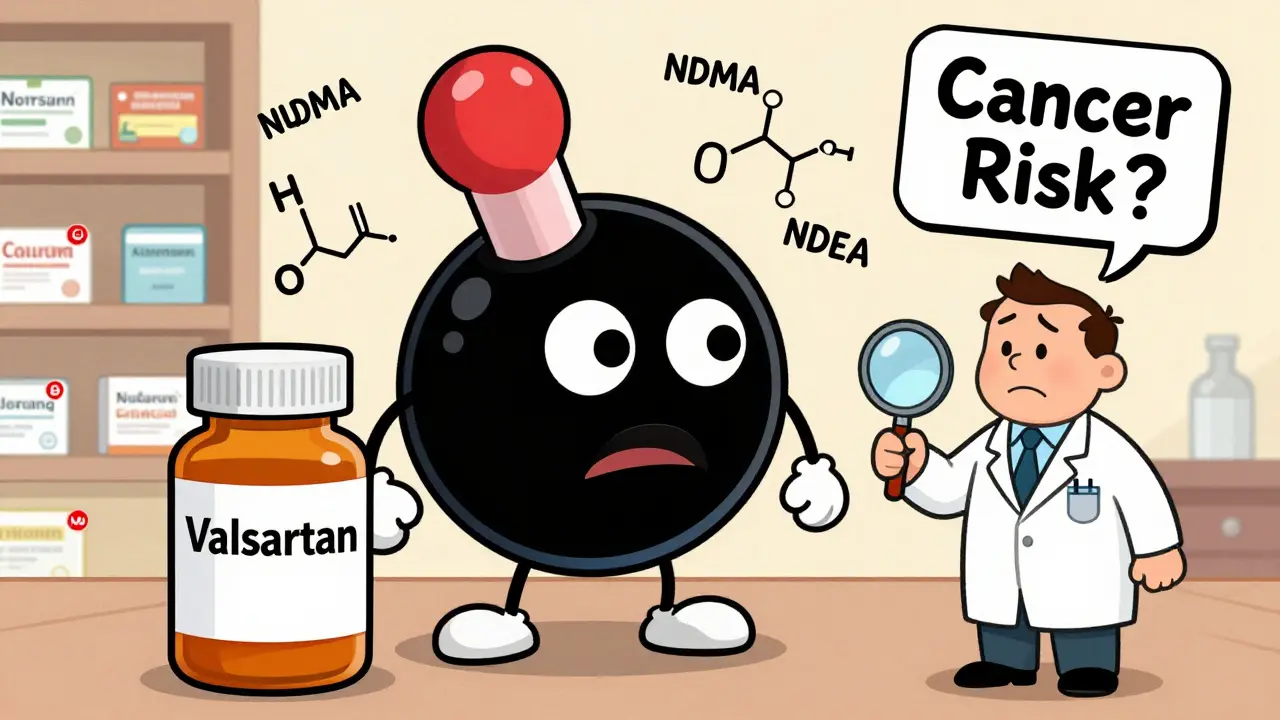
Since 2018, a quiet but dangerous problem has been creeping into generic medicines millions of people rely on every day. It’s not about fake pills or expired stock. It’s about invisible chemicals-nitrosamines-that can form during manufacturing and may raise cancer risk, even at tiny levels. These aren’t random errors. They’re chemical byproducts that slipped through gaps in quality control, and they’ve triggered one of the biggest drug safety crises in modern history.
How Did Nitrosamines Get Into Our Medicines?
Nitrosamines aren’t added on purpose. They form when certain chemicals in the drug-making process react under heat, pressure, or during storage. Think of it like rust on metal-but inside a pill. Secondary amines, common in active ingredients, can combine with nitrites (found in some excipients like magnesium stearate or even water) to create compounds like NDMA (N-Nitrosodimethylamine) or NDEA (N-Nitrosodiethylamine). These are classified as probable human carcinogens by the International Agency for Research on Cancer.
The first big red flag came in 2018 when the FDA found NDMA in valsartan, a blood pressure medication made by a Chinese supplier. Within weeks, recalls spread to other ARBs-losartan, irbesartan-and then to ranitidine (Zantac), metformin, duloxetine, and even varenicline (Chantix). By mid-2025, over 500 drug products had been pulled from shelves globally due to nitrosamine levels exceeding FDA’s strict limits.
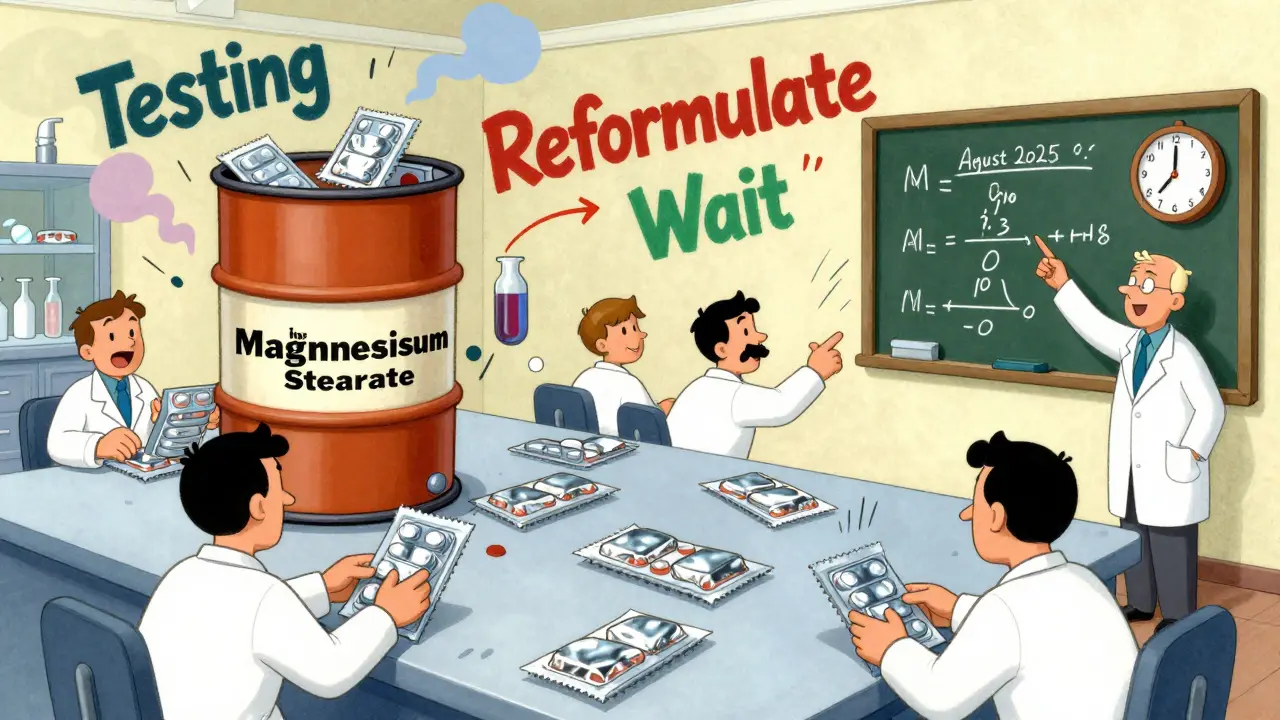
What shocked manufacturers wasn’t just the number of recalls-it was how hard it was to trace the source. One company spent 18 months and $2 million just to fix nitrosamine formation in its metformin line. The culprit? Nitrite impurities in magnesium stearate from a single supplier. That one batch contaminated three different blood pressure drugs. Another case revealed that the problem wasn’t even in the tablet itself-it was in the blister pack. Adhesives and plastic liners released amines that reacted with nitrites over time, creating nitrosamines during shelf life. Packaging, once ignored, is now a major risk factor.
FDA’s Evolving Rules and the New Deadline Shift
The FDA didn’t wait. By 2023, it published detailed guidance setting acceptable intake limits for each nitrosamine. For NDMA, it’s 96 nanograms per day. For NDEA, it’s 26.5 ng/day. But here’s the twist: if a drug contains multiple nitrosamines, the total exposure must stay under 100% of the combined risk. Two impurities at 80% of their individual limits? That’s a 160% risk-unacceptable.
Then came the August 1, 2025 deadline for compliance with controls for nitrosamine drug substance-related impurities (NDSRIs)-compounds unique to specific drugs like N-nitroso-varenicline. Manufacturers braced for shutdowns. But in June 2025, the FDA quietly changed course. Instead of requiring full compliance by August, they now accept detailed progress reports. Companies must show they’ve identified the root cause, started testing, and are working on reformulation. The goal? No more rushed fixes that create new problems.
This shift didn’t come from compassion. It came from reality. One manufacturer told the FDA: “We fixed one pathway, and three new nitrosamines showed up.” Reformulating a generic drug isn’t like swapping a battery. It requires revalidating every step-raw materials, reaction conditions, drying temps, storage conditions, packaging. And for small companies? It’s a financial wall. Testing alone costs $500,000 to $2 million a year. Most can’t afford it.
Who’s Getting Hit the Hardest?
It’s not just one type of drug. It’s a pattern: high-volume, low-margin generics. Blood pressure pills, diabetes meds, antidepressants. These are the drugs people take for life. When they’re pulled, shortages follow. Between 2018 and 2020, 15-20% of ARB supplies vanished from U.S. pharmacies. Patients switched to more expensive brand names-or went without.
The crisis hit small and mid-sized manufacturers hardest. Big players like Teva, Sun Pharma, and Fresenius Kabi had the labs, the chemists, and the cash to test early and reformulate. Smaller firms? Many shut down or were bought out. Evaluate Pharma estimates that compliance costs have cut generic drug profit margins by 3-5 percentage points. That’s not a number-it’s a survival issue.
Even the U.S. isn’t alone. The European Medicines Agency has issued 32 recalls. Health Canada, the UK’s MHRA, and Japan’s PMDA have each seen 5-15. But the FDA’s approach is the strictest. While EMA gives more time, the FDA demands compound-specific limits and requires manufacturers to prove they’ve eliminated every possible pathway. That’s why U.S. recalls outnumber all others combined.
What’s Being Done Now?
Companies that survived did three things right:
- Tested early-even before the FDA asked.
- Changed suppliers for excipients, especially those with nitrite risks.
- Redesigned processes to avoid high-heat steps that trigger nitrosamine formation.
One manufacturer avoided a recall entirely by switching from sodium stearate to calcium stearate in their metformin formula. Simple swap. Big difference. Another replaced plastic bottle liners with aluminum foil blisters after finding amines leaching from the plastic.
Testing methods have gotten smarter too. Labs now use liquid chromatography-tandem mass spectrometry (LC-MS/MS) to detect nitrosamines at 0.3 ng/mL-equivalent to one drop in an Olympic pool. But these machines cost over $500,000. Only big labs can afford them. That’s why many smaller companies outsource testing, adding delays and cost.
What This Means for You
If you’re taking a generic blood pressure, diabetes, or depression pill, here’s what you need to know:
- Your medicine is still safe if it hasn’t been recalled.
- The FDA doesn’t recall every batch-only those above the limit.
- There’s no need to stop taking your meds unless your pharmacist or doctor tells you to.
- If your prescription was recently switched to a different generic brand, it might be because the old one had contamination.
Don’t panic. But do stay informed. Check the FDA’s website for recall notices. Ask your pharmacist if your generic has been tested for nitrosamines. Most major pharmacies now track this data.
What’s Next?
The FDA says this isn’t over. They’re expanding testing to other drug classes, including antibiotics and antivirals. Nitrosamine controls are now a permanent part of drug approval. New generic applications must include full nitrosamine risk assessments before they’re even reviewed.
Manufacturers are being pushed to innovate-not just to fix problems, but to prevent them. Some are building AI models to predict nitrosamine formation based on process parameters. Others are using green chemistry to eliminate amine-based reagents entirely.
For patients, the takeaway is simple: trust the system, but stay aware. The FDA’s response has been slow, expensive, and messy-but it’s also the most transparent drug safety effort in decades. The goal isn’t perfection. It’s reducing risk to levels so low they’re nearly impossible to measure. And for millions taking daily pills, that’s worth the fight.
Are generic drugs still safe to take if they haven’t been recalled?
Yes. The FDA only recalls batches that exceed the strict nitrosamine limits. Most generic drugs on the market today have been tested and cleared. If your medication hasn’t been listed in a recall notice, it’s considered safe to use. Do not stop taking your medicine without talking to your doctor.
What’s the difference between NDMA and NDEA?
Both are nitrosamine impurities linked to cancer risk, but they have different chemical structures and acceptable limits. NDMA (N-Nitrosodimethylamine) has a limit of 96 nanograms per day, while NDEA (N-Nitrosodiethylamine) is more potent and has a lower limit of 26.5 nanograms per day. The FDA sets separate limits for each because their cancer risk levels differ, even at tiny amounts.
Why did the FDA delay the August 2025 deadline?
The FDA realized that fixing nitrosamine contamination isn’t simple. Many manufacturers needed more time to identify root causes, source new materials, revalidate processes, and collect stability data. Instead of forcing rushed fixes that could create new risks, the agency now accepts detailed progress reports. This gives companies breathing room to do it right.
Can packaging cause nitrosamine contamination?
Yes. Starting in 2022, the FDA confirmed that blister packs and bottle liners made with amine-based materials can release chemicals that react with nitrites in the drug over time. This means contamination can happen after the pill is made-during storage. Manufacturers are now switching to aluminum foil blisters and non-reactive packaging to prevent this.
How can I check if my generic drug has been recalled?
Visit the FDA’s official drug recall page at fda.gov/safety/recalls. You can search by drug name, manufacturer, or lot number. Your pharmacist can also check for you. If your drug is on the list, they’ll help you get a safe replacement.
Are brand-name drugs affected by nitrosamine contamination?
Rarely. Brand-name drugs were mostly cleared early in the crisis because they had more resources to test and reformulate before generic versions hit the market. Some, like the original Zantac, were pulled because they contained ranitidine, which naturally breaks down into NDMA. But most brand-name drugs now have stronger controls and are less likely to be affected.
Will nitrosamine testing become standard for all new drugs?
Yes. Since 2024, the FDA requires all new generic drug applications to include a full nitrosamine risk assessment. This includes evaluating raw materials, chemical reactions, and packaging. It’s now a mandatory part of the approval process, not an afterthought.


sakshi nagpal
The FDA’s shift in deadlines shows they’re finally listening to industry realities. This isn’t about cutting corners-it’s about avoiding worse mistakes. I’ve seen labs burn out trying to fix one nitrosamine only to find three new ones pop up. Patience here isn’t weakness; it’s science.