
Bisphosphonate & Calcium Timing Calculator
How to Use This Tool
Enter the times you take your bisphosphonate and calcium supplement to check if your timing meets the required 2-hour gap. The correct gap is essential for proper absorption and effectiveness.
Why Your Bisphosphonate Might Not Be Working
You’re taking your bisphosphonate like your doctor told you-early in the morning, on an empty stomach. You even wait 30 minutes before eating. But your bone density isn’t improving. You’re not alone. Around half of people taking oral bisphosphonates like alendronate or risedronate don’t get the full benefit-not because the drug doesn’t work, but because they’re accidentally blocking it with something they’re taking right after: calcium supplements.
Bisphosphonates are powerful drugs designed to slow bone loss in osteoporosis. They stick to bone tissue like glue, stopping the cells that break down bone (osteoclasts) from doing their job. But here’s the catch: these drugs are picky eaters. They only absorb properly if your stomach is completely empty and free of anything that binds to calcium. And calcium supplements? They’re the #1 offender.
The Science Behind the Blockade
Bisphosphonates have a chemical structure that loves calcium. Too much. In fact, their phosphate groups latch onto calcium ions like magnets. That’s great when they’re targeting your bones-but terrible when they meet calcium from a pill, yogurt, or even a glass of fortified orange juice.
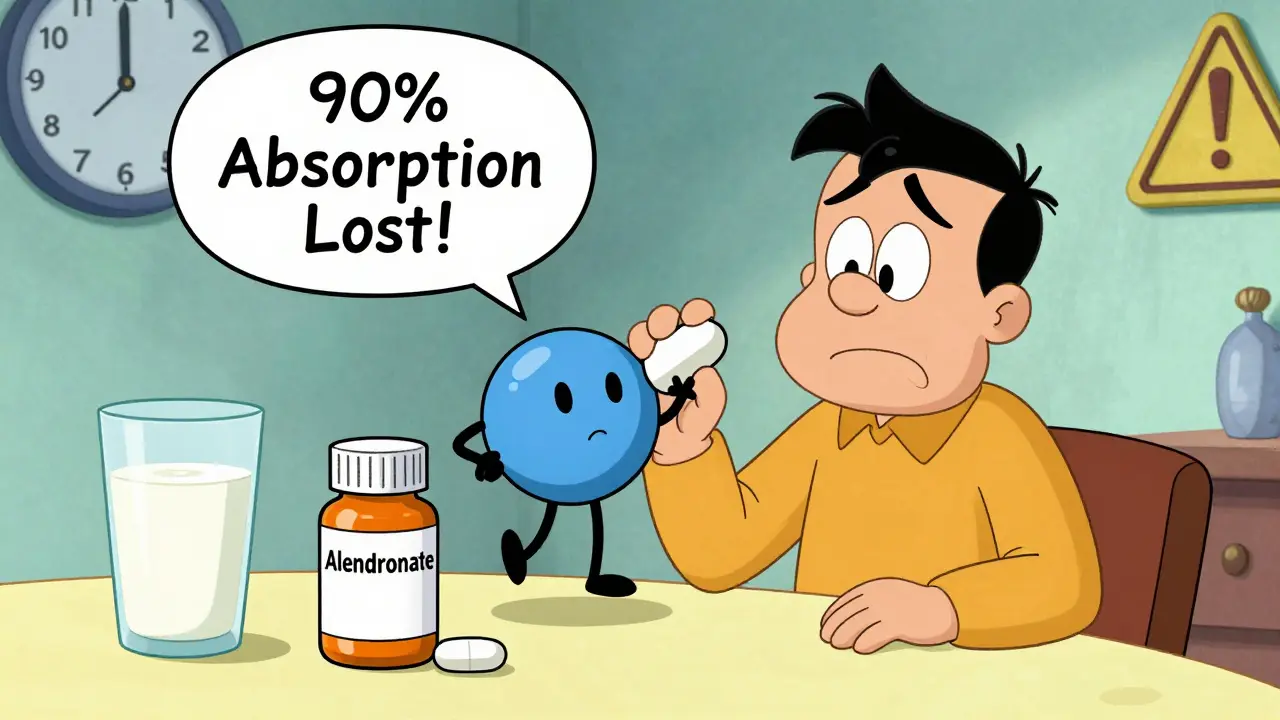
Studies show that if you take calcium within two hours of your bisphosphonate, absorption drops by 90% to nearly 100%. That means instead of 1% of the drug entering your bloodstream (which is already low), you’re getting 0.1%. At that level, the drug might as well be water.
This isn’t theory. It’s been proven in clinical trials. One 2008 study gave people alendronate with a calcium supplement and measured blood levels. Result? No detectable drug. Same thing happened with iron, magnesium, and antacids. The moment these minerals show up, the bisphosphonate becomes useless.
What Counts as a Calcium Interferer?
It’s not just calcium pills. Anything with calcium can throw off your dose:
- Calcium carbonate (Tums, Caltrate)
- Calcium citrate (Citracal)
- Multivitamins with calcium
- Fortified milk, plant milks, or orange juice
- Dairy products (yogurt, cheese, cottage cheese)
- Antacids like Maalox or Mylanta
- Iron or magnesium supplements
Even a single glass of fortified almond milk right after your pill can wipe out its effectiveness. You don’t need a full supplement-just a few hundred milligrams of calcium is enough to block absorption.
The Right Way to Take Your Bisphosphonate
There’s a strict, non-negotiable protocol. Skip any step, and you’re wasting your medication.
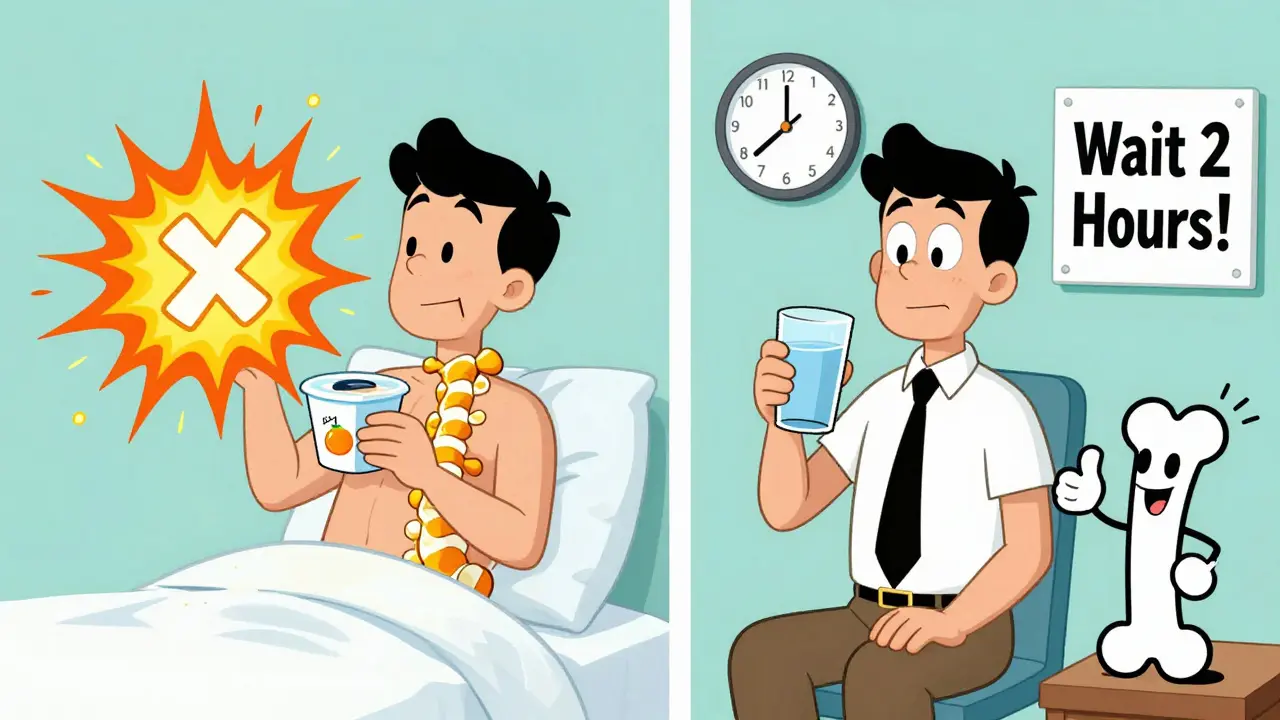
- Take it first thing in the morning, before anything else-not even coffee or toothpaste. Wait at least 30 minutes after brushing your teeth if you’ve used fluoride toothpaste (fluoride can also interfere).
- Use plain water only. No tea, juice, soda, or mineral water. Even sparkling water has minerals that can bind to the drug.
- Stay upright for 30 to 60 minutes after taking it. Lying down increases the risk of the pill sticking to your esophagus, which can cause serious irritation or ulcers.
- Wait at least 30 minutes before eating or drinking anything else.
- Wait at least 2 hours before taking calcium, iron, or antacids.
That’s it. No exceptions. If you eat toast with almond butter at 7:30 AM, your 7:00 AM pill is already ruined. If you take calcium at 6:00 PM, you’re fine-but you can’t take your bisphosphonate after 4:00 PM.
Calcium Citrate vs. Calcium Carbonate: Does It Matter?
Some people think calcium citrate is safer because it’s absorbed better on an empty stomach. That’s true-but it doesn’t help here. Both forms bind to bisphosphonates just as strongly. The difference between them matters for how well your body absorbs calcium, not how well your bisphosphonate works. So whether you take Citracal or Tums, if you take it too close to your bisphosphonate, you’re blocking it.
What About IV Bisphosphonates?
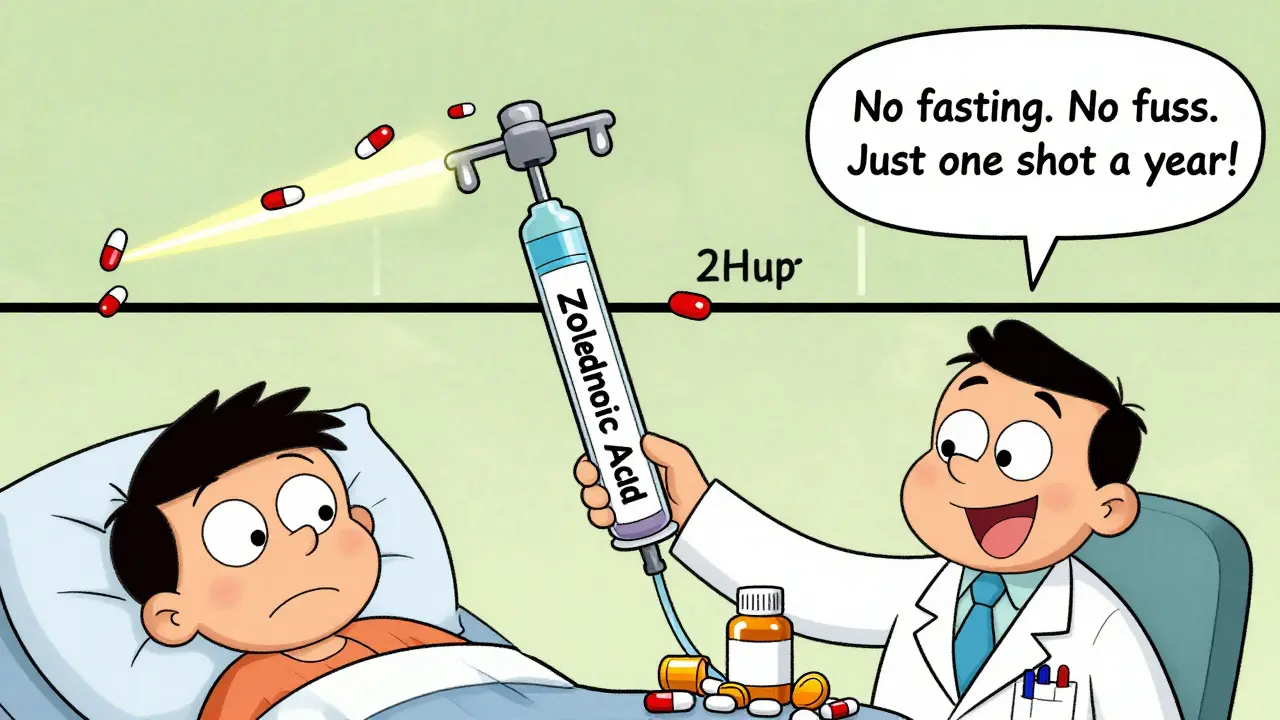
If you keep messing up the timing, there’s a simpler option: the shot. Zoledronic acid (Reclast) is given once a year through an IV. No fasting. No waiting. No calcium conflicts. It goes straight into your bloodstream, bypassing your gut entirely.
Studies show 78% of patients stick with the yearly IV dose, compared to just 52% who manage daily pills. That’s a huge difference. And for older adults or those with memory issues, the IV is often the smarter choice. You don’t have to remember to take it every day. You just show up once a year.
Real People, Real Mistakes
Online patient forums are full of stories:
- "I took my alendronate at 7 AM, then had my protein shake with calcium at 7:15. I did this for six months. My doctor said my bone density didn’t improve. I had no idea why."
- "I started taking calcium at bedtime to avoid the conflict. Now I take my pill at 5 AM and calcium at 8 PM. Works like a charm."
- "I forgot and took my pill with my morning coffee and yogurt. I got heartburn for a week. My pharmacist said that’s what happens when the pill sticks to your throat."
One Reddit user posted a detailed plan: wake up at 5 AM, take pill, drink water, sit upright, wait until 5:30 AM to brush teeth, then wait until 7:00 AM to eat. Calcium at 8 PM. No exceptions. He got 1,400 upvotes.
What Your Doctor Should Be Telling You
Too often, patients are handed a prescription and told, "Take this on an empty stomach." That’s not enough. A 2022 study found that patients who got a 15-minute counseling session from their doctor or pharmacist had 37% fewer mistakes.
Your provider should:
- Ask if you’re taking calcium supplements
- Draw out a daily schedule with you
- Confirm you understand the 2-hour gap
- Offer the IV option if you’re struggling
If your doctor doesn’t bring this up, ask. It’s not your fault if you didn’t know.
Vitamin D Is Part of the Puzzle
Here’s something most people miss: bisphosphonates don’t work well if you’re low on vitamin D. Your body needs vitamin D to absorb calcium from food. If you’re deficient, your bones can’t rebuild properly-even if the bisphosphonate is working.
Doctors should check your vitamin D level before starting treatment. The target? At least 30 ng/mL. If you’re below that, you’ll need a supplement-taken at least 2 hours after your bisphosphonate.
The Future: Better Drugs Coming
Researchers are working on solutions. One new oral version of zoledronic acid, called RAY121, uses a special coating that lets the drug absorb even with calcium nearby. Early trials show it works 15 times better than current pills. It’s not on the market yet, but it’s coming.
Other companies are testing pills that separate the bisphosphonate and calcium into different layers, releasing them hours apart. Think of it like a timed-release capsule for bone health.
But until then, the rules haven’t changed. If you’re on an oral bisphosphonate, calcium is your enemy-unless you keep it at least two hours away.
What to Do If You’ve Been Taking Them Together
If you’ve been taking calcium and bisphosphonates at the same time, don’t panic. Stop doing it now. Talk to your doctor about getting a bone density scan to see if your treatment is working. If your bone density hasn’t improved, switching to the yearly IV shot might be your best move.
And if you’re already taking the IV? Great. You’ve already solved the problem.
Final Rule: Timing Is Everything
Bisphosphonates are effective. But only if you take them right. The difference between success and failure isn’t the drug-it’s the timing. You can’t outsmart biology. Calcium binds to bisphosphonates. That’s chemistry. No magic pill, no workaround. Just two hours apart.
Set a phone alarm. Write it on your calendar. Stick a note on your fridge. Do whatever it takes. Your bones are counting on it.


Alec Stewart Stewart
I took my alendronate with my morning coffee and yogurt for months... heartburn city. 🤯 Finally figured it out after my pharmacist yelled at me. Now I take it at 5 AM, wait till 7:30 to eat, and calcium at 8 PM. Life changed.