
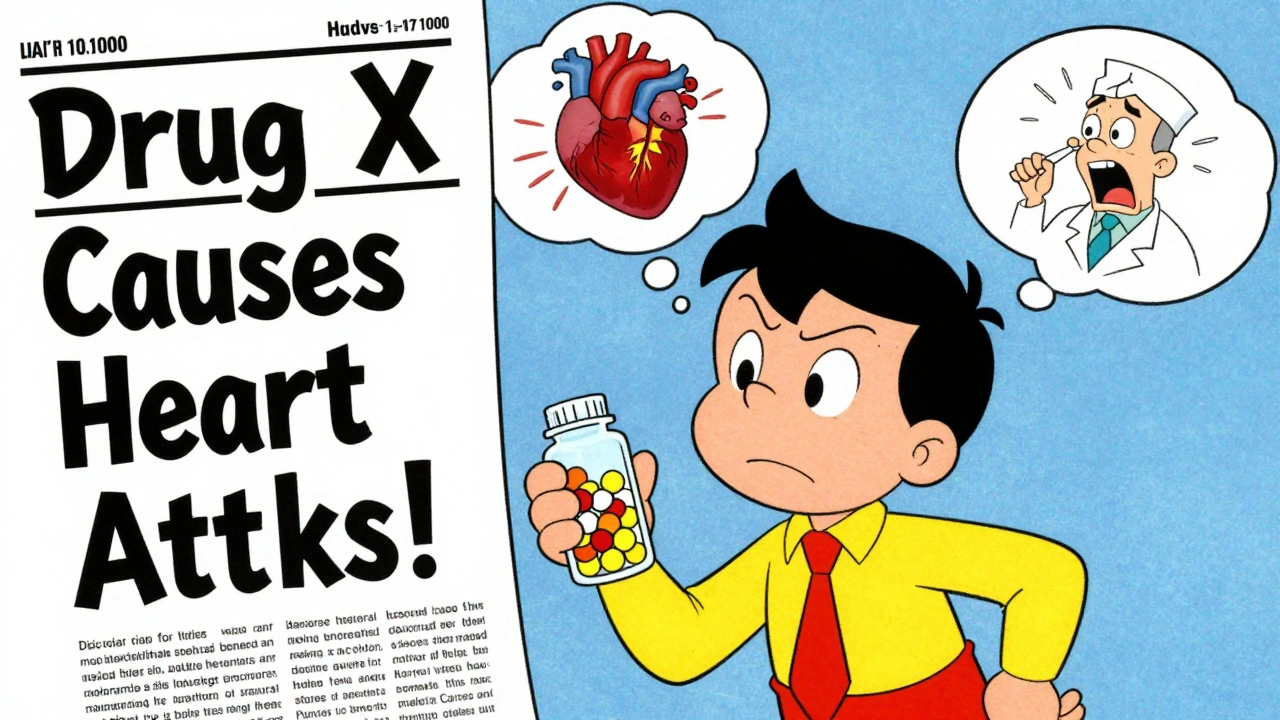
When you read a headline like "New Study Links Blood Pressure Drug to Heart Attacks", it’s natural to panic. You might stop taking your medicine. You might call your doctor in a rush. But what if that headline is misleading? What if the study didn’t even look at the dose you’re taking? Or if the real risk is 1 in 10,000 - not 1 in 10? Media reports about medication safety can save lives. But they can also cause real harm - if you don’t know how to read them right.
Understand the difference between medication errors and adverse drug reactions
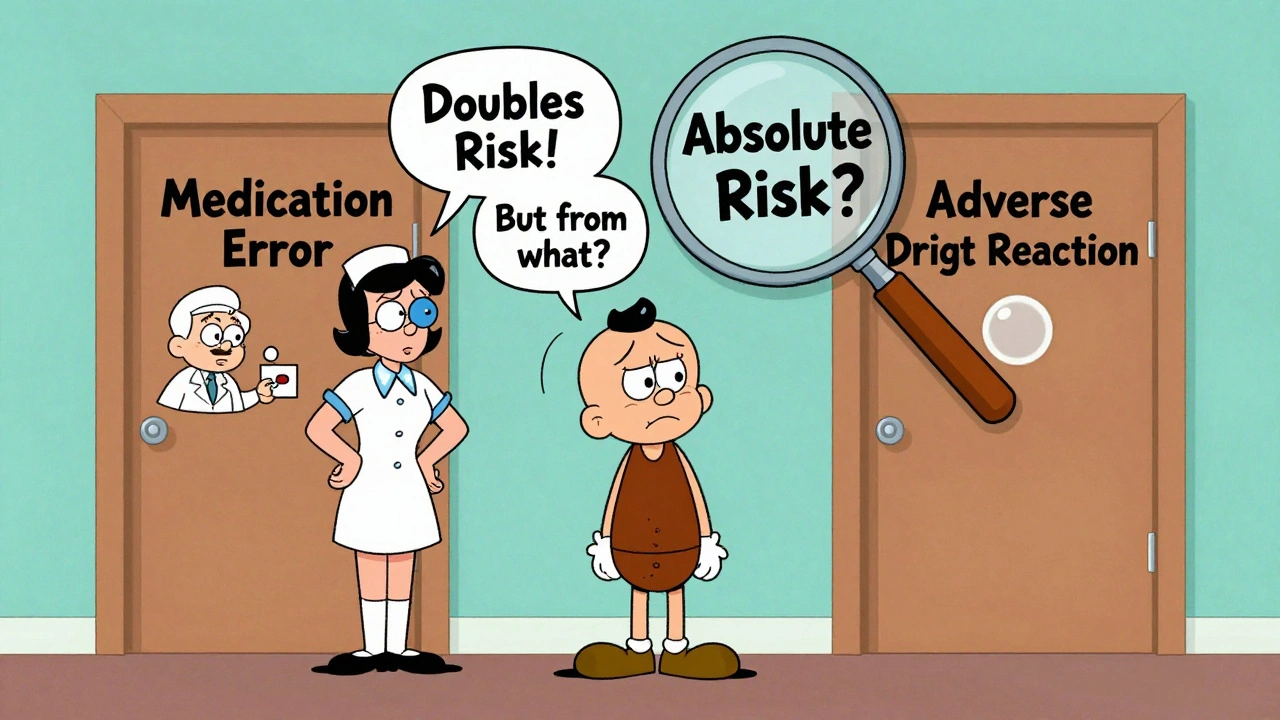
Not every bad outcome from a drug is the drug’s fault. That’s the first thing to check. A medication error is something that went wrong in the process: a pharmacist gave the wrong dose, a nurse misread the label, a doctor prescribed something that interacts badly with another drug you’re on. These are preventable. An adverse drug reaction (ADR) is a harmful effect caused directly by the drug itself - even when taken correctly. Some ADRs are rare but unavoidable. Most media reports mix these up. A 2021 study in JAMA Network Open found that 68% of news articles didn’t say which one they were talking about. If a report says a drug is "dangerous" without clarifying whether it’s about human mistakes or the drug’s inherent risk, you’re not getting the full picture.Look for absolute risk - not just relative risk
Here’s where most headlines trick you. Say a study finds that Drug X doubles your risk of liver damage. Sounds scary, right? But if your baseline risk was 1 in 10,000, doubling it means 2 in 10,000. That’s still extremely low. If the study only says "doubles risk," it’s using relative risk - a tool journalists love because it makes numbers sound dramatic. The BMJ analyzed 347 news stories on medication risks and found that only 38% reported absolute risk. The FDA’s 2022 guidelines say both must be included. If a report doesn’t give you the actual number of people affected, it’s incomplete. Always ask: "Out of how many people?"Check the study method - not just the headline
How was the data collected? That’s critical. There are four main ways researchers study medication safety:- Incident reports: Hospitals or doctors voluntarily report problems. Easy to collect, but only 5-10% of real events get reported. Many serious cases go unreported.
- Chart reviews: Researchers dig through patient records. More accurate than incident reports, but still only catch a fraction of events.
- Direct observation: Someone watches how drugs are given in real time. Most accurate - but expensive and rare.
- Trigger tools: A smart system flags red flags in electronic records (like a sudden spike in potassium levels after a new drug). This is the most efficient method and was developed by experts at Brigham and Women’s Hospital.
Don’t trust spontaneous reports as proof of cause
You’ll often see headlines like: "FDA receives 500 reports of heart issues after taking Drug Y." That sounds alarming. But here’s the truth: the FDA’s FAERS database collects any report - whether the drug caused it or not. Someone might have had a heart attack because they smoked, didn’t exercise, or had undiagnosed heart disease. The drug might have nothing to do with it. A 2021 study in Drug Safety found that 56% of media reports treated FAERS data as proof of harm. That’s wrong. FAERS is a warning system - not a proof of causation. Real safety conclusions need controlled studies comparing people who took the drug with those who didn’t.Verify the source - and look for bias
Who wrote this? Where did the data come from? A 2020 BMJ study showed that major newspapers like the New York Times and Guardian got the risk numbers right 62% of the time. Cable news? Only 38%. Digital-only outlets? Just 22%. Also, check if the report mentions the study’s limitations. A 2021 audit found that 79% of media stories didn’t explain them. Did the study only look at older adults? Did it control for other health conditions? Was the sample size too small? If none of that’s mentioned, the report is incomplete. Look for citations. Does the article link to the original study? If not, try searching the journal name and authors on clinicaltrials.gov or PubMed. You don’t need to read the whole paper - just the abstract and methods section. If the report says "a recent study," but you can’t find it, that’s a red flag.Use trusted benchmarks
There are real-world standards you can check against:- ASHP Guidelines (2023): These are the gold standard for hospital medication safety. If a report claims a hospital is unsafe, ask: "Did they follow ASHP’s monitoring protocols?"
- ISMP’s List of Error-Prone Abbreviations: If a report talks about "U" for units (which can be mistaken for "0"), or "QD" (which can be read as "QID"), and doesn’t mention this, the reporter hasn’t checked the most basic safety resources.
- Leapfrog Hospital Safety Grade: This free public tool rates hospitals on how well they prevent medication errors. Only 22% of local news reports reference it. If your hospital’s grade is "A," don’t believe a story claiming it’s unsafe without proof.
- WHO’s ATC Classification: Does the report correctly name the drug class? A 2022 analysis found nearly half of media reports misclassified drugs - calling a blood thinner an antidepressant, for example.
Watch out for AI-generated and social media noise
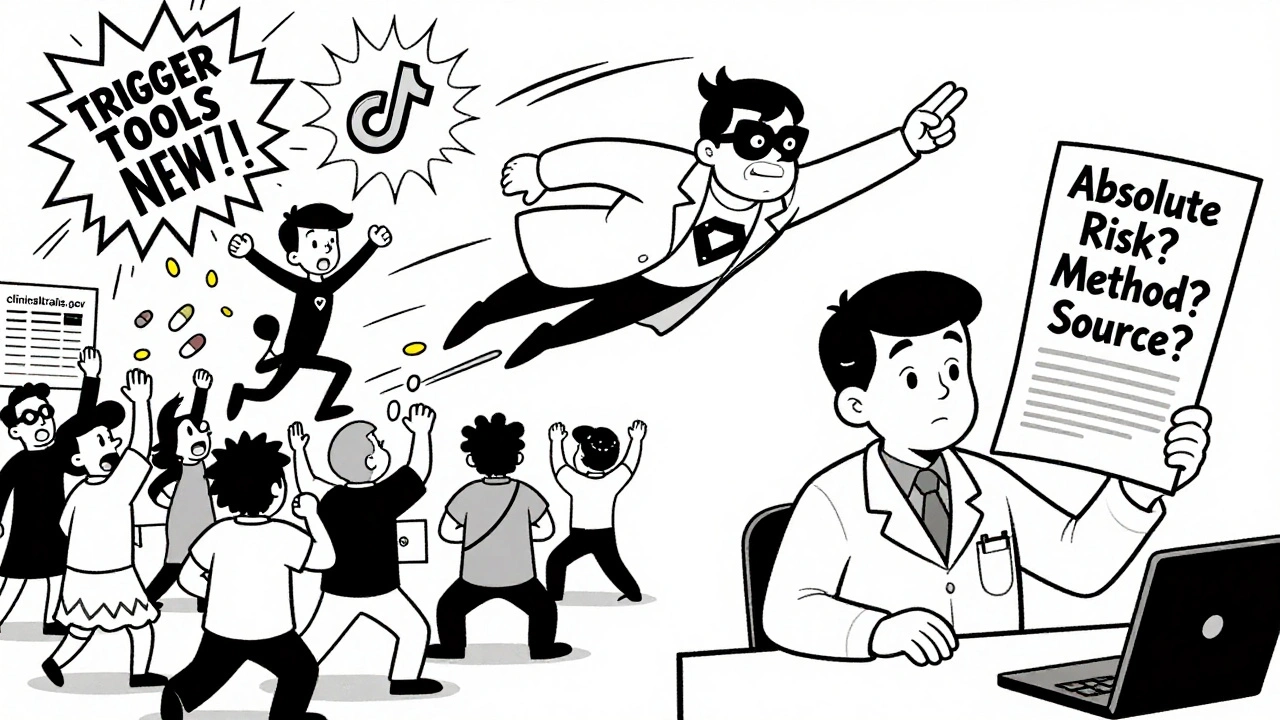
AI tools are now writing health content. A 2023 Stanford study found that 65% of AI-generated medication safety articles had serious factual errors - especially around risk numbers. TikTok and Instagram are the worst offenders. A 2023 analysis by the National Patient Safety Foundation found that 68% of medication safety claims on Instagram were wrong. On traditional media? It was 41%. A Reddit thread from 2022 went viral after a news story claimed a blood pressure drug was "deadly." The catch? The study used doses 10 times higher than anyone ever takes. That detail was buried in paragraph 12. People stopped their meds. Some ended up in the ER.What should you do when you see a scary headline?
Here’s your quick checklist:- Is it a medication error or an adverse reaction? Look for the distinction.
- What’s the absolute risk? Find the actual number of people affected.
- What method was used? Was it trigger tools, chart reviews, or just spontaneous reports?
- Did they mention limitations? Sample size? Confounding factors? Bias control?
- Is the source trustworthy? Did they cite the study? Do they link to FAERS or clinicaltrials.gov?
- Did they use ISMP or ASHP standards? If not, they might be missing key safety context.


Rob Purvis
Wow, this is one of the clearest breakdowns of media manipulation I’ve seen on meds. I’ve been telling my mom for years that ‘doubles your risk’ doesn’t mean ‘you’re gonna die’-but she still panics every time a headline pops up. The absolute vs. relative risk point? Gold. I print this out and give it to anyone who starts yelling about ‘the pharmaceutical conspiracy.’
Also, trigger tools? I had no idea they existed. That’s way more reliable than those sketchy FAERS reports that get turned into TikTok horror stories. Someone should make a browser extension that auto-highlights absolute risk numbers in articles. I’d use it daily.