
Medication Absorption Calculator
How Absorption Works
Your digestive system is a complex barrier that determines how much of your medication actually enters your bloodstream. Factors like food, disease, timing, and formulation can dramatically affect absorption—sometimes by over 50%.
Important Note
This calculator provides estimated absorption based on typical scenarios. Individual results may vary due to your unique gut physiology, other medications, and health conditions. Always consult with your doctor or pharmacist for personalized advice.
Have you ever taken a pill and wondered why it didn’t seem to work-even when you followed the instructions exactly? For many people, especially those with digestive conditions like Crohn’s disease, ulcerative colitis, or short bowel syndrome, the problem isn’t the drug itself. It’s how well (or poorly) it gets absorbed in the gut. Gastrointestinal medications face a hidden battle before they even reach your bloodstream, and that battle decides whether they help you-or do nothing at all.
Why Your Stomach Isn’t a Simple Delivery System
Most pills you take are meant to be swallowed, dissolve, and get absorbed through your intestines. Sounds simple, right? But the digestive tract isn’t just a tube. It’s a complex, changing environment with layers of barriers designed to keep things out-not let them in. Your gut has a thick mucus layer, tight junctions between cells, enzymes that break down foreign substances, and transporters that actively push drugs back out. These aren’t flaws-they’re protections. But for medications, they become roadblocks.Take a drug like levothyroxine, used for thyroid replacement. If you take it with breakfast, especially something fatty, absorption drops by up to 50%. That’s why doctors tell you to take it on an empty stomach, 30 to 60 minutes before eating. The same goes for antibiotics like ciprofloxacin, which bind to calcium in dairy products and become useless. It’s not that the drug is weak. It’s that your gut is fighting it.
The Small Intestine: The Real Absorption Zone
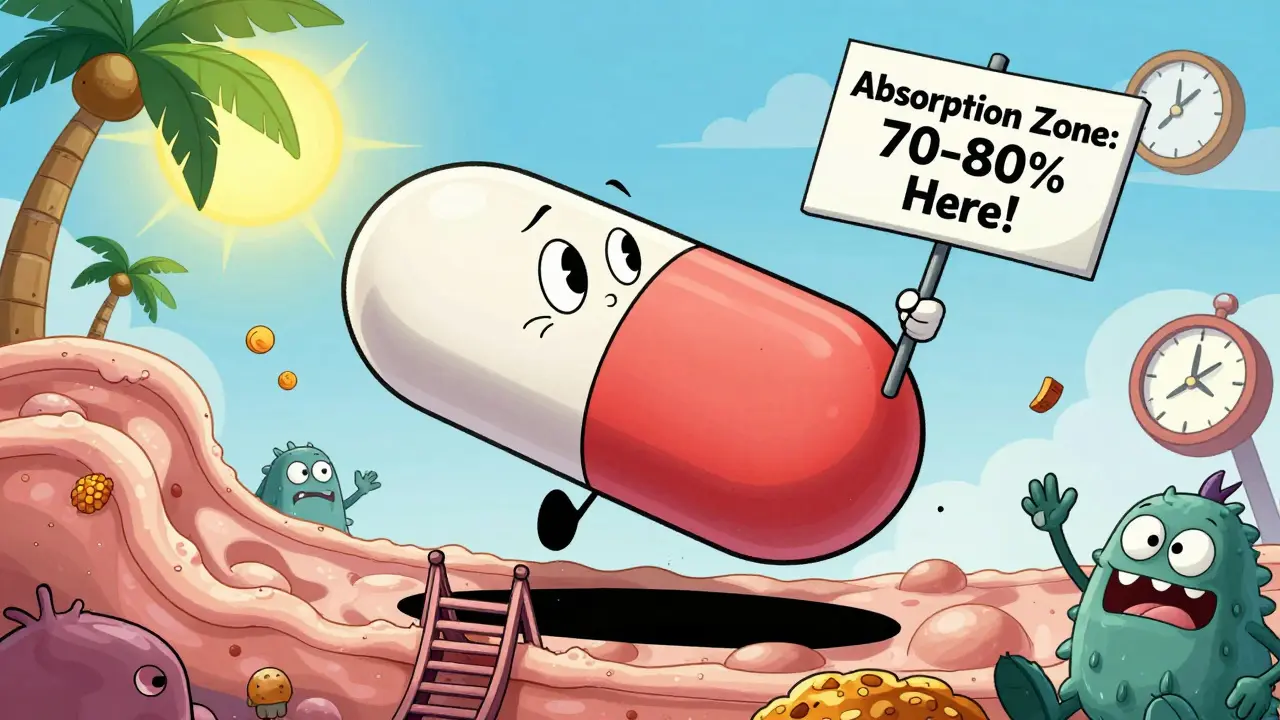
Most drugs don’t get absorbed in the stomach. They pass through it quickly and land in the small intestine, which has a surface area bigger than a tennis court-thanks to millions of tiny finger-like projections called villi and microvilli. This is where 70-80% of oral drugs are absorbed. But even here, things get tricky.The pH changes as you move down the intestine. It starts around 5.5 near the stomach and rises to nearly 8 near the end. Drugs that dissolve best in acid (like aspirin) get stuck if they move too slowly. Drugs that need a higher pH (like some antibiotics) might not dissolve at all if they pass through too fast. And if your gut moves too slowly-like in constipation-or too quickly-like in diarrhea-your drug doesn’t have time to be absorbed. That’s why people with irritable bowel syndrome (IBS) often report inconsistent effects from the same dose of medication.
What Makes Some Drugs Just Not Work
Not all drugs are created equal when it comes to absorption. Small, fatty molecules (like diazepam or atorvastatin) slip through intestinal walls easily. They often reach 70-100% of their intended dose in the blood. But larger, water-soluble drugs? Forget it. Insulin, for example, has a molecular weight over 5,800 Da. Without special delivery systems, less than 1% gets absorbed. That’s why insulin must be injected.Even among pills, formulation matters. A regular tablet of mesalamine (used for ulcerative colitis) might dissolve too early and get destroyed by stomach acid. A delayed-release version (like Asacol HD) is designed to reach the colon. But if the colon is inflamed and damaged, the drug doesn’t get absorbed properly. Patients with severe inflammation can see bioavailability drop by 40%. One patient on a Crohn’s forum wrote: “My Remicade levels swing from undetectable to therapeutic-same dose, same day, same everything. My gut just won’t cooperate.”

Food, Disease, and the Hidden Variables
Food isn’t just a distraction-it’s a game-changer. Fatty meals slow gastric emptying by 2 to 4 hours. That means drugs that need to be absorbed quickly-like the antibiotic metronidazole-can sit in the stomach too long and degrade. Other drugs, like griseofulvin (used for fungal infections), actually absorb better with food because fat helps dissolve them.Disease changes everything. In Crohn’s disease, parts of the intestine may be scarred or removed. In short bowel syndrome, patients might have only 30 cm of small intestine left. Normal doses of vitamins, antibiotics, or blood thinners just don’t cut it. Nurses on Medscape report that patients with short bowel syndrome often need 2-3 times the standard dose of fat-soluble vitamins (A, D, E, K) just to stay stable.
Even newer drugs like semaglutide (Ozempic, Wegovy) affect absorption. They slow down gut movement. That’s great for weight loss and blood sugar-but bad if you’re also taking warfarin or digoxin. Pharmacists have seen INR levels (a measure of blood thinning) jump from 1.5 to 4.5 in IBD patients on warfarin, even when the dose hasn’t changed. That’s a serious risk of bleeding.
How Drug Companies Are Trying to Fix This
The pharmaceutical industry knows this is a huge problem. That’s why they’re spending billions on absorption enhancers. Sodium caprate, chitosan, and medium-chain fatty acids are being tested to temporarily open up tight junctions in the gut, letting drugs slip through more easily. In lab studies, these enhancers have boosted absorption by 20% to 200%.Nanoparticles and liposomes are another big advance. These tiny fat-based carriers can wrap up poorly soluble drugs and ferry them past the mucus layer and efflux pumps. One study showed a 3.5-fold increase in bioavailability for a cancer drug using this method.
But here’s the catch: most of these improvements are still in labs or clinical trials. Only 15-20% of oral drugs on the market today have specific dosing instructions for people with GI diseases. The rest? Their labels say “take with or without food,” with no mention of Crohn’s, IBS, or surgery. That leaves doctors guessing.
What Patients and Clinicians Can Do
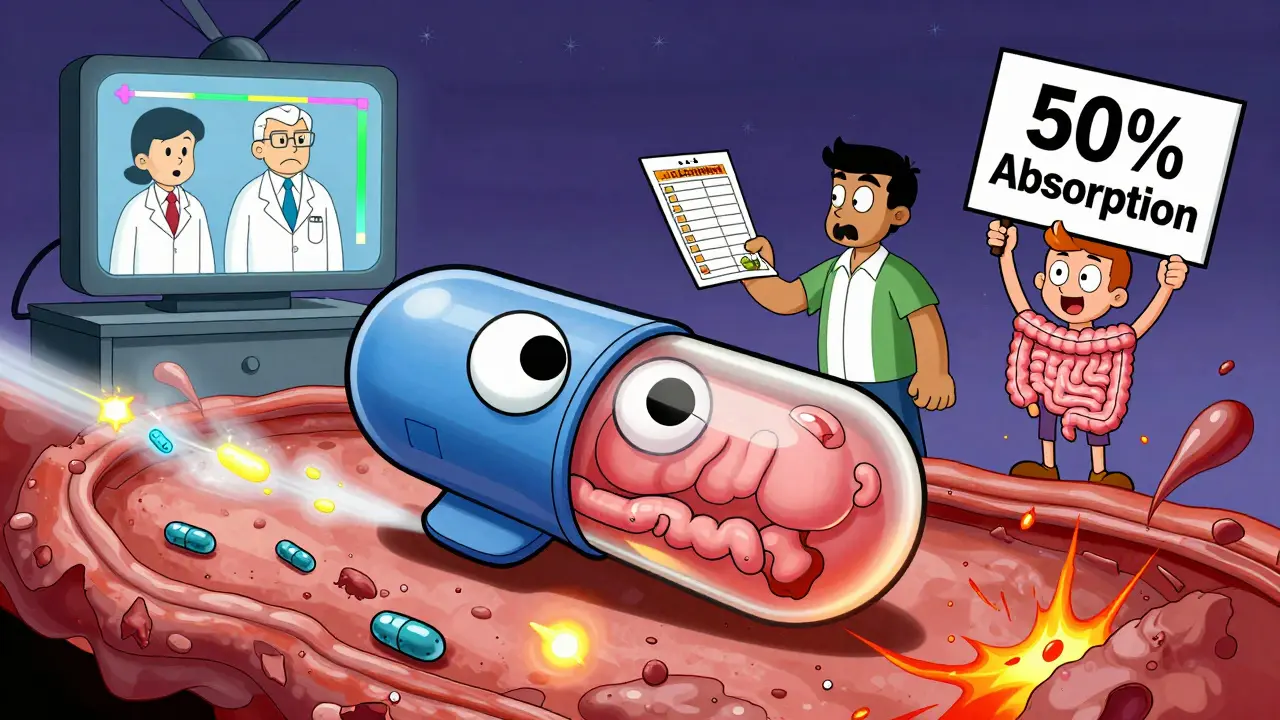
If you’re taking a GI medication and it’s not working, don’t assume it’s your fault. Ask these questions:- Is this drug supposed to be taken on an empty stomach? If yes, how long before or after eating?
- Could my food, supplements, or other meds be blocking absorption? (Calcium, iron, antacids, and even fiber can interfere.)
- Do I have a condition that changes how my gut works? (IBS, Crohn’s, surgery, gastroparesis?)
- Is there a different formulation available? (Liquid, chewable, delayed-release, or extended-release?)
For children, swallowing pills is hard. Oral suspensions or chewables are often better. For older adults or those with swallowing issues, crushing pills isn’t always safe-some are designed to release slowly. Always check with a pharmacist.
Doctors and pharmacists need to think beyond the pill. They need to consider the patient’s gut as a dynamic system-not a fixed pipe. A drug that works for one person with ulcerative colitis might fail for another, even with the same diagnosis. That’s why personalized dosing is the future. Early trials are testing smart capsules with sensors that measure pH and pressure in real time to guide when and how much to give.
The Bottom Line
Gastrointestinal medications don’t fail because they’re weak. They fail because the gut is complicated, variable, and often damaged. The same dose can mean the difference between relief and no effect-depending on what you ate, how fast your gut moves, whether you’ve had surgery, or how inflamed your lining is. There’s no one-size-fits-all answer.If you’re struggling with inconsistent results from your GI meds, talk to your pharmacist. Bring your food diary. Ask about formulation options. And don’t accept “it should work” as an answer. Your gut is unique. Your medication should be too.


Kuldipsinh Rathod
Been there. Took my mesalamine like clockwork, but my flares kept coming back. Turns out, I was taking it right after my coffee with milk. My pharmacist caught it-calcium was nuking the absorption. Switched to water-only, 45 mins before breakfast, and holy crap, I actually feel like a human again.