

When you pick up a prescription at the pharmacy, the label on the bottle might look like any other. But for certain medications, that small print holds legal weight. Under U.S. federal law, drugs classified as controlled substances come with strict rules about how they’re prescribed, labeled, and dispensed. These rules aren’t arbitrary-they’re built into a five-tier system called the Controlled Substances Act (CSA), created in 1970 to track who’s using what, and why.
What Makes a Drug a Controlled Substance?
Not every prescription drug is controlled. The U.S. government only labels a substance as controlled if it meets two key criteria: it has a recognized medical use, and it carries a risk of abuse or dependence. The decision isn’t made by doctors or pharmacists-it’s made by the U.S. Attorney General, based on scientific reviews from the FDA and the Department of Health and Human Services.Once a drug is classified, it’s placed into one of five schedules. Each schedule has different rules for prescribing, refilling, and storing the medication. The system was designed to create a "closed loop"-so every step, from manufacturer to patient, is documented and monitored. Pharmacies, doctors, and even drug makers must register with the DEA to handle these substances.
The Five Schedules: From Highest Risk to Lowest
Understanding the schedule number on your prescription label tells you more than just the drug’s name. It tells you how dangerous it is considered to be, how tightly it’s controlled, and what you can and can’t do with it.
- Schedule I: These drugs have no accepted medical use in the U.S. and a high potential for abuse. Examples include heroin, LSD, and (as of 2025) marijuana under federal law-even though 38 states allow medical use. Schedule I substances can’t be prescribed, sold, or legally possessed under federal regulations.
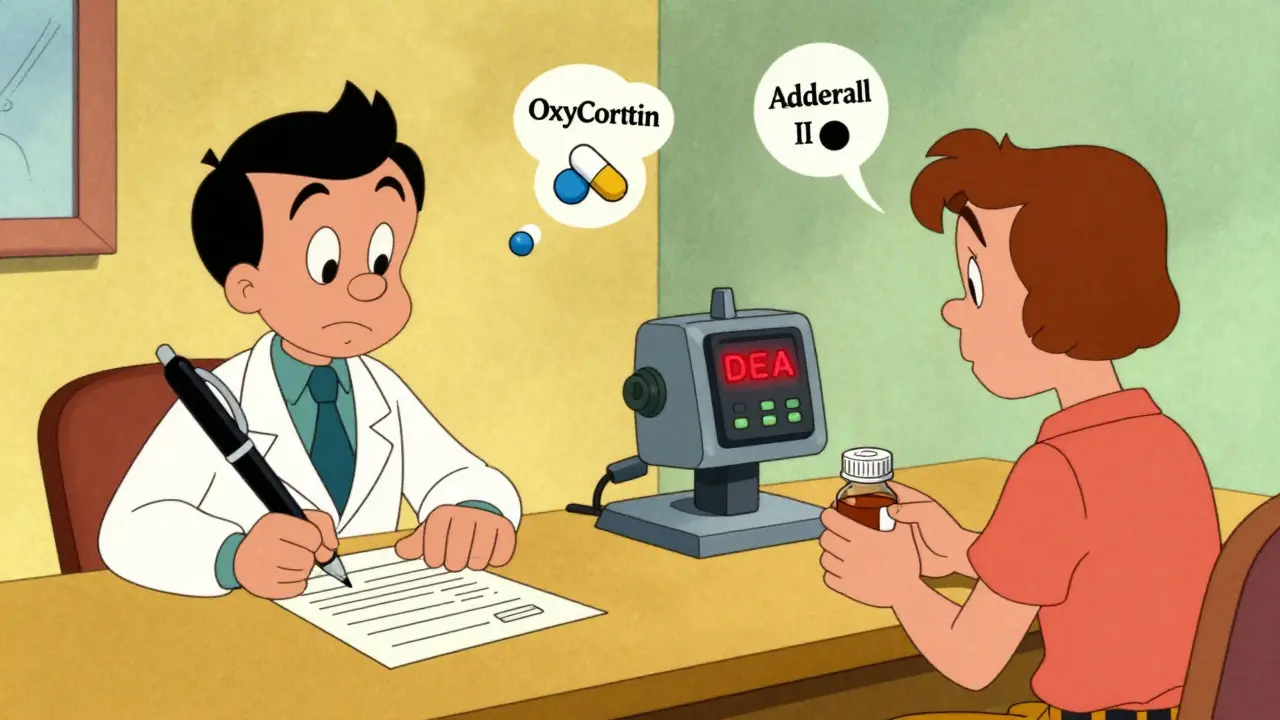
- Schedule II: These drugs have high abuse potential but are used medically. They can lead to severe physical or psychological dependence. Common examples include oxycodone (OxyContin), fentanyl, Adderall, and morphine. Prescriptions for these drugs cannot be refilled. Each fill requires a new, original paper prescription in most states (though some allow electronic prescriptions under strict conditions). Pharmacies must store them separately, and prescriptions are tracked in real-time through state databases.
- Schedule III: Abuse potential is lower than Schedule II, but still present. These include medications like ketamine, anabolic steroids, and combination products with less than 90 mg of codeine per dose (like Vicodin or Tylenol with codeine). Prescriptions can be refilled up to five times within six months. Electronic prescriptions are allowed.
- Schedule IV: Lower abuse potential. These are commonly prescribed for anxiety or sleep issues-think Xanax, Valium, Ambien, and tramadol. Refills are allowed up to five times in six months. Electronic prescribing is standard.
- Schedule V: Lowest risk. These include cough syrups with small amounts of codeine (under 200 mg per 100 ml) and antidiarrheal meds with atropine/diphenoxylate. Some can be bought over-the-counter in limited quantities, with pharmacist oversight. Refills are generally permitted without restrictions.
Why the Same Drug Can Be in Different Schedules
It might surprise you that codeine can appear in three different schedules. Pure codeine? Schedule II. Codeine combined with acetaminophen in a 15 mg dose? Schedule III. Codeine in a cough syrup with only 1.5 mg per 5 ml? Schedule V. The difference isn’t the drug-it’s the formulation and concentration.
This matters because it affects how you get it. A patient needing strong pain relief after surgery might get Schedule II oxycodone. But someone with a mild cough might get a Schedule V cough syrup at the pharmacy counter. The label on the bottle will clearly show the schedule code: "CSA SCH II" or "CSA SCH V." Pharmacists rely on this to know how to handle the prescription.
What’s on the Label? More Than Just Directions
Controlled substance labels don’t just say "take one tablet daily." They include mandatory DEA identifiers:
- The Controlled Substance Code Number (CSCN)-a unique number assigned by the DEA to each substance.
- The schedule designation (e.g., "Schedule II").
- A warning that refills are not permitted (for Schedule II).
- For Schedule II, the prescription must be printed on tamper-resistant paper in most states.
Pharmacists scan these labels into systems that link to state prescription drug monitoring programs (PDMPs). If a patient tries to fill a Schedule II prescription at two different pharmacies in one week, the system flags it. That’s not surveillance-it’s safety.
Why the System Is Both Necessary and Flawed
Doctors and pharmacists often say the scheduling system saves lives. In oncology, for example, nurses report that tracking Schedule II opioids helps prevent misuse and ensures patients get the pain relief they need without overprescribing.
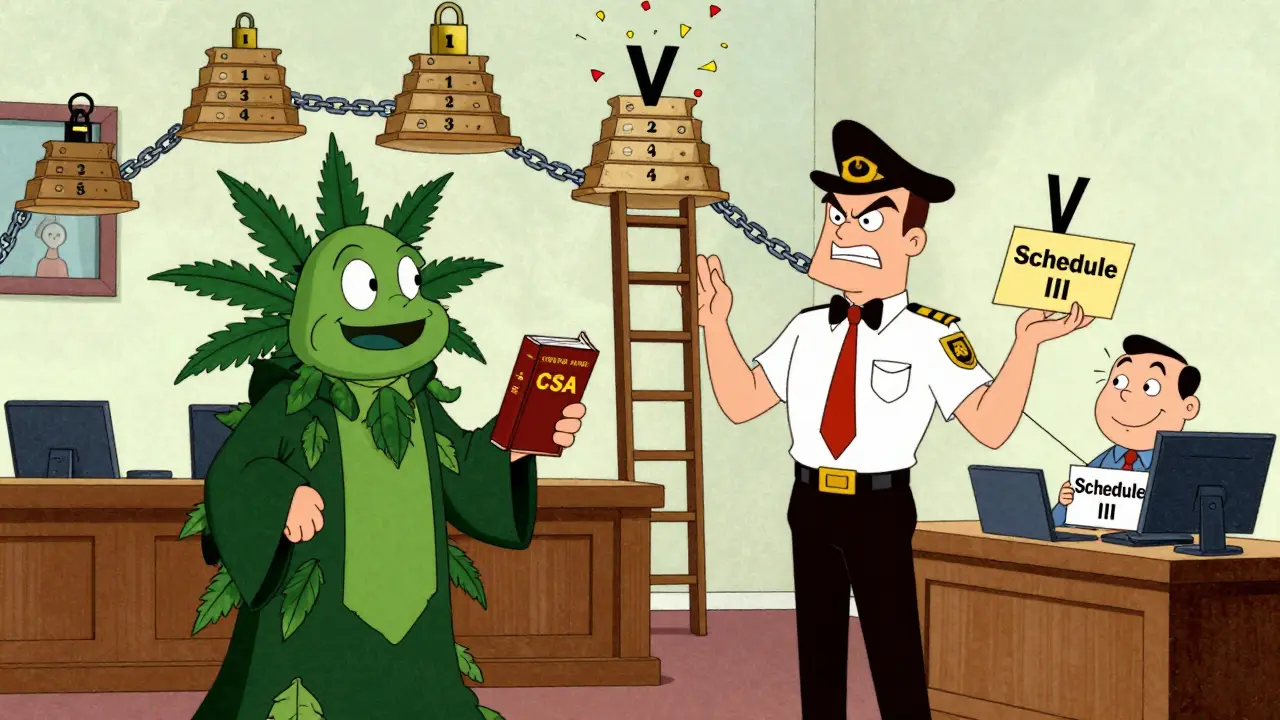
But there are big problems. Cannabis remains Schedule I, even though it’s legally prescribed in 38 states. That creates confusion for patients and providers. A cancer patient using medical marijuana legally in California is still breaking federal law. And the DEA’s classification hasn’t kept up with science-substances like MDMA and psilocybin show real therapeutic promise, yet remain locked in Schedule I.
Some experts argue the system is outdated. A 2023 survey by Deloitte found 68% of healthcare policy analysts believe at least two Schedule I drugs will be rescheduled by 2028. The Biden administration has already initiated a review of cannabis scheduling, with a decision expected soon. If cannabis moves to Schedule III, it would open the door for more research, insurance coverage, and legal clarity for millions of patients.
What This Means for Patients
If you’re prescribed a controlled substance, here’s what you need to know:
- Never share your medication-even with family members. It’s illegal and dangerous.
- Keep your prescriptions secure. Theft of Schedule II drugs is common.
- Don’t try to refill a Schedule II prescription early. Pharmacists can’t do it, no matter how much you need it.
- Ask your pharmacist: "What schedule is this?" They’re trained to explain it.
- If you’re on a long-term Schedule III or IV medication, ask about non-controlled alternatives. Sometimes there are safer, equally effective options.
For patients with chronic pain or mental health conditions, the system can feel frustrating. Waiting for a new prescription every month, dealing with pharmacy delays, or being denied refills because of paperwork-it adds stress to an already difficult situation.
How the System Is Changing
The DEA has started modernizing. Since 2021, the Controlled Substance Ordering System (CSOS) lets pharmacies order Schedule II drugs electronically, cutting delivery time from days to under 24 hours. More states are allowing electronic prescriptions for Schedule II, reducing the need for paper.
But the biggest shift may be coming from the top. In August 2023, the Department of Health and Human Services recommended moving cannabis from Schedule I to Schedule III. If approved, it would be the most significant change to the system in over 50 years. Experts predict more substances-like MDMA for PTSD and psilocybin for depression-could follow.
By 2025, the DEA aims to cut the average time to reschedule a drug from two years to one. That’s a big step toward making the system more responsive to science, not politics.
What You Should Do Next
If you’re taking a controlled substance:
- Check the label for the schedule code. It’s usually printed near the bottom.
- Know your refill rules. Schedule II? No refills. Schedule IV? Up to five in six months.
- Ask your prescriber: "Is there a non-controlled alternative?" Sometimes there is.
- Store your medication safely. Keep it locked up, away from teens or visitors.
- If you’re running low, call ahead. Don’t wait until the last day.
Understanding your medication’s schedule isn’t just about following rules-it’s about staying safe, avoiding legal trouble, and getting the best care possible. The system isn’t perfect, but knowing how it works gives you power over your own treatment.
What does it mean if my prescription says "Schedule II"?
It means the medication has a high potential for abuse and can cause severe dependence. Common examples include oxycodone, fentanyl, and Adderall. You cannot refill this prescription. Each time you need more, your doctor must write a new one. In most states, the prescription must be on special tamper-resistant paper, and pharmacies must track it in real time through state databases.
Can I get a Schedule II drug without a prescription?
No. Schedule II drugs are strictly controlled and require a written or electronic prescription from a licensed provider. Even if you’ve taken the same medication before, you cannot get a refill without a new prescription. Attempting to obtain these drugs without a prescription is a federal crime.
Why is codeine sometimes Schedule III and sometimes Schedule V?
It depends on the concentration and combination. Pure codeine is Schedule II. When mixed with acetaminophen in doses under 90 mg per tablet, it becomes Schedule III. When it’s in a cough syrup with less than 200 mg per 100 ml, it’s Schedule V. The lower the dose and the more it’s diluted, the less risk it’s considered to have-and the fewer restrictions apply.
Can I travel with my controlled substance prescription?
Yes, but only if you follow the rules. Always carry your medication in its original prescription bottle with your name and the prescribing doctor’s information. For Schedule II drugs, bring the original prescription or a printed copy. Don’t pack them in checked luggage. If you’re flying, inform TSA agents if asked. State laws vary, so check the rules of your destination.
Is marijuana still a Schedule I drug?
Under federal law, yes. Despite being legal for medical or recreational use in 38 states, marijuana remains classified as Schedule I-meaning it has no accepted medical use and high abuse potential. However, the Department of Health and Human Services recommended in 2023 that it be moved to Schedule III. A final decision is expected soon, which could change how doctors prescribe it and how pharmacies handle it.


Bennett Ryynanen
Yo, this is wild-my buddy got caught with a refill on his Oxy script last month. DEA came knocking. He didn’t even know it was Schedule II. How are people supposed to know this stuff unless it’s screaming at them from the bottle?