

When a medical device fails, a toy breaks, or a car part malfunctions, the public expects safety. But behind every product recall or safety alert is a legal requirement most people never see: manufacturer reporting. Companies that make products - from heart monitors to baby strollers - don’t just hope problems get fixed. They’re legally forced to report them. And if they don’t? Fines, lawsuits, and shutdowns can follow.
What Exactly Are Manufacturer Safety Reporting Obligations?
Manufacturer reporting means companies must tell government agencies when their products cause or could cause harm. It’s not about waiting for lawsuits. It’s about catching problems early. The U.S. has three main systems, each covering different products:- FDA’s Medical Device Reporting (MDR) - for pacemakers, insulin pumps, surgical tools, and other medical devices.
- CPSC’s Section 15(b) - for household goods like toasters, cribs, ladders, and electronics.
- NHTSA’s Early Warning Reporting - for cars, tires, and vehicle parts.
Each system has its own rules, but the core idea is the same: if you know your product might hurt someone, you have to say so - fast.
How Fast Do You Have to Report?
Timing isn’t optional. Miss the deadline, and you’re in violation.For medical devices under the FDA, manufacturers must report deaths or serious injuries within 30 days. If the problem requires immediate action - like a recall - they have just 5 working days. That’s not a suggestion. It’s a legal clock that starts ticking the moment someone in the company, even a customer service rep, learns about it.
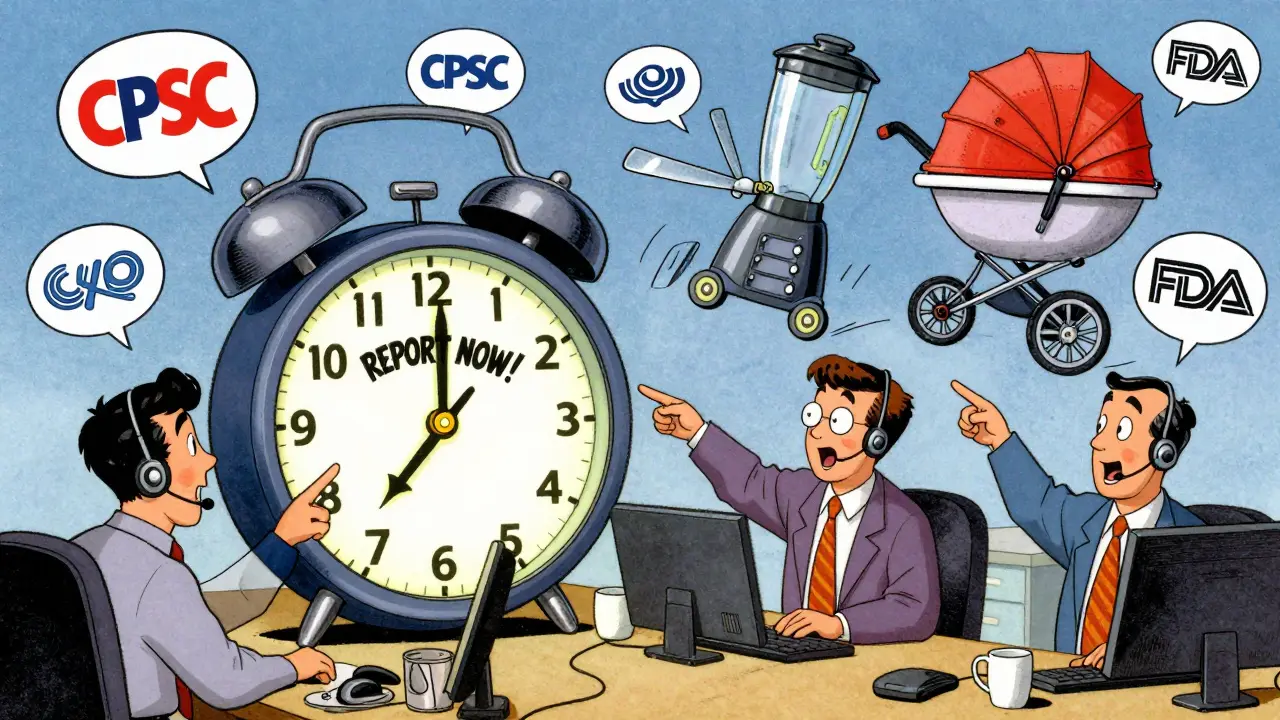
The CPSC is even stricter. For consumer products, you have 24 hours to report once you have “reportable information.” That means you don’t need proof someone got hurt. If you know a product could cause serious injury - say, a blender blade that can fly off - you report it within a day. No delay. No waiting for complaints to pile up.
NHTSA works differently. Car makers don’t report every single incident. They submit quarterly data on crashes, injuries, and deaths tied to specific models. But if a tire model causes five or more deaths, they must trigger a deeper report. It’s threshold-based, not event-based.
What Counts as a Reportable Event?
Not every glitch needs reporting. But the line is blurry.FDA MDR requires reporting for:
- Deaths linked to device use
- Serious injuries (hospitalization, permanent damage, life-threatening conditions)
- Malfunctions that would likely cause death or injury if they happened again
That last one is the trickiest. A glucose monitor giving wrong readings once? Maybe not reportable. But if it happens twice in different hospitals? Now you’ve got a pattern. And that’s reportable.
CPSC focuses on risks, not outcomes. You report if your product:
- Has a defect that creates a substantial risk of injury
- Presents an unreasonable risk of serious injury or death
- Doesn’t meet a safety standard
There’s no need to wait for a child to choke on a toy part. If the design makes choking likely, you report it. That’s why companies now design products with safety testing long before they hit shelves.
Who’s Responsible Inside the Company?
It’s not just the legal team. Reporting obligations hit every department.Customer service gets calls. Sales hears complaints. Engineering sees returns. Any employee who might pass along safety info to someone who handles compliance - that’s enough to trigger the clock.
That’s why companies build internal systems. A quality manager in Perth might get an email from a distributor in Texas saying a ventilator alarm failed. That email lands in a shared inbox. The system flags it. The quality team investigates. Within hours, they decide: Is this reportable? If yes, the clock starts.
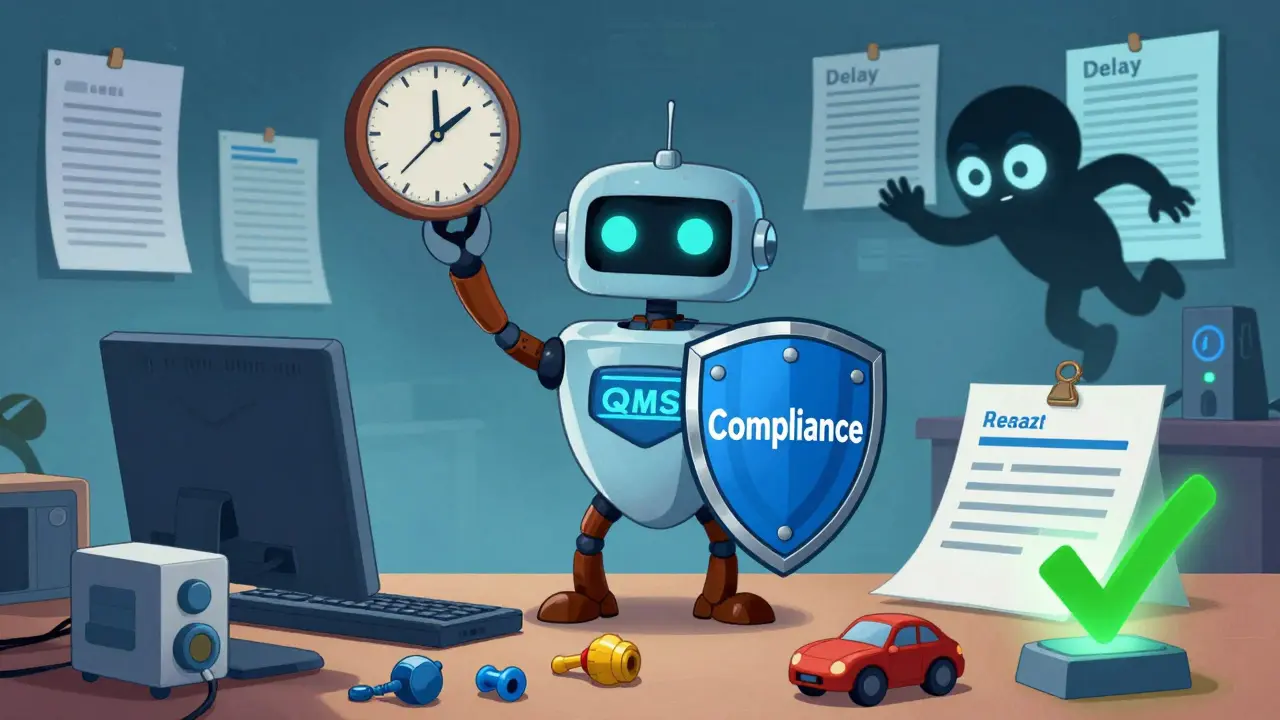
Many companies now use digital quality management systems (QMS) to track complaints, automate alerts, and ensure nothing slips through. These systems cost between $185,000 and $750,000, depending on size. But the alternative - a $252,756 fine per violation - makes it worth it.
What Happens When You Don’t Report?
The penalties aren’t small.The FDA can fine a company up to $252,756 for each missed report. The CPSC can do the same. And those aren’t just numbers. In 2023, 54% of home appliance makers got warning letters from the CPSC for late reporting. Only 31% of medical device firms got FDA warnings - but that’s because the FDA’s system is more mature. CPSC enforcement is catching up.
Beyond fines, there’s reputational damage. A single delayed report can spark a media storm. Regulators start auditing. Customers lose trust. And if a child gets hurt because you knew about a defect and didn’t act? The civil lawsuits can bankrupt you.
Why Do Some Companies Struggle?
It’s not that companies want to break the law. They’re overwhelmed.A 2023 survey found 68% of medical device manufacturers spend more than $50,000 a year just on reporting. Small firms with under 50 employees spend nearly 20% of their entire quality budget on compliance.
One quality manager on Reddit said: “We had three FDA inspectors give us three different answers on whether the same malfunction was reportable.” That’s the problem. The rules are complex. Interpretations vary. Training staff takes 40 to 80 hours.
And then there’s the 24-hour CPSC deadline. One manufacturer said: “We had to hire two full-time people just to file reports.” That’s not efficiency. That’s survival.
How Are Things Changing?
The system isn’t frozen. It’s evolving.In August 2024, the FDA expanded its Voluntary Malfunction Summary Reporting program. Instead of filing 100 individual reports for the same type of glitch, companies can now submit one summary. Medtronic cut its individual reports by 63% after switching. That’s a win - less paperwork, more analysis.
The FDA is also rolling out a new Unique Device Identification (UDI) system by 2026. Each device will have a barcode-like ID. That means if a problem occurs, regulators can trace it back to the exact batch, factory, and even the person who assembled it. No more guessing.
AI is coming too. Philips Healthcare now uses machine learning to scan complaints and flag potential safety issues. It cut report prep time from 8.2 hours to 3.5 hours per case. That’s not science fiction - it’s happening now.
What Should Your Company Do?
If you make a product that touches people’s lives, here’s your checklist:- Know which agency governs your product - FDA, CPSC, or NHTSA?
- Train every team - customer service, engineering, sales - on what counts as “reportable information.”
- Set up a digital system to log, track, and escalate complaints.
- Assign clear ownership: Who decides if it’s reportable? Who files it?
- Keep records for at least two years after the product’s last sale.
- Review your reporting process every six months. Rules change. Your team shouldn’t be guessing.
Don’t wait for a crisis. Build your system before the first complaint comes in. Because when it does, you won’t have time to learn.
Is Reporting Worth the Cost?
Yes. And here’s why.The FDA gets over 1.2 million medical device reports every year. That’s not noise - it’s early warning. In 2022, a report about a faulty insulin pump led to a recall that prevented dozens of overdoses. That’s one company’s report saving lives.
CPSC’s 24-hour rule might feel harsh, but it’s why children’s toys are safer today than they were in 2008. The Consumer Product Safety Improvement Act forced companies to think ahead. Now, lead paint and small magnets are rare in toys because manufacturers know they’ll be held accountable.
Reporting isn’t about punishment. It’s about responsibility. The system isn’t perfect. It’s messy, slow, and expensive. But it’s the only thing standing between a flawed product and a child in the hospital.
If you’re a manufacturer, your job isn’t just to make things that work. It’s to make sure they don’t break in ways that hurt people. And if they do? You report it. Fast. Honestly. Without excuses.
What products require manufacturer safety reporting?
Any product regulated by federal agencies requires reporting. This includes medical devices (FDA), consumer goods like toys and appliances (CPSC), and vehicles or vehicle parts (NHTSA). Even over-the-counter drugs have reporting rules under the FD&C Act. If your product affects health or safety, you’re likely covered.
Do I need to report if no one got hurt?
Yes. The CPSC requires reporting if a product has a defect that creates a substantial risk of injury - even if no injury has occurred yet. The FDA also requires reporting for malfunctions that could cause harm if they recur. Waiting for a real injury means you’ve already failed your duty to protect users.
How long do I have to keep reporting records?
For FDA-regulated medical devices, you must keep MDR records for at least two years after the device’s last distribution or manufacture date, whichever is later. CPSC requires retention of records for five years. NHTSA requires five years of data retention. Always check your specific agency’s rules.
Can I get help with reporting?
Yes. The FDA and CPSC offer free guidance documents, webinars, and compliance tools. Industry associations like the Medical Device Manufacturers Association (MDMA) and the Association of Home Appliance Manufacturers (AHAM) provide templates and training. Many companies also hire compliance consultants or use specialized software to automate reporting.
What’s the biggest mistake companies make?
Waiting to confirm a problem before reporting. Many companies wait for multiple complaints or internal investigations to conclude. But the law says “when you become aware.” That’s the moment the clock starts - not when you’re 100% sure. Delaying because you want more data is a common reason for violations.
Are small businesses treated differently?
No. The rules apply equally to everyone. But the FDA and CPSC do offer simplified guidance and resources for small businesses. Still, 62% of medical device makers are small, yet they file only 28% of reports - suggesting many are underreporting due to lack of resources or awareness.


Katie Schoen
So let me get this straight - if my toaster starts shooting sparks and I don’t report it until I’ve gotten three emails from angry customers, I’m already breaking the law? 😅
CPSC’s 24-hour rule is either genius or insane. I’m leaning toward ‘genius if you’re not the one filing the report.’